
Acacia Cores for Cost-Controlled Formwork
Not every formwork programme needs a twenty-cycle panel. Dongstar Wood's ordinary black range bonds acacia veneers from Vietnam plantation forests with melamine adhesive that passes a boiling test of about 10 hours, and states a reuse of approximately 3–5 times under normal site conditions — a working surface for budgets that count every sheet.
Key takeaways
- The core is acacia veneers from Vietnam plantation forests, bonded with melamine.
- The adhesive passes a boiling test of about 10 hours — the 10 Hours Boiling Test named on the page.
- Published reuse is approximately 3–5 times under normal site conditions.
- Best-selling thicknesses for European buyers are 21 mm, then 18 mm; 1250 × 2500 mm is the most requested format.
What the ordinary black range is for
The Black Film Faced Plywood range is positioned honestly: the economical option. The page describes a competitive cost per project, a stable acacia core, a smooth concrete surface finish and easier handling, supplied to distributors, builders and formwork companies. The positioning matters because it tells the buyer which projects the panel is designed for — programmes where the shuttering stock is bought, used a handful of times and moved on, rather than panels that must cycle through twenty pours. Buying the twenty-cycle panel for a three-pour job is waste; buying the three-cycle panel for a twenty-pour job is a delay.
The acacia core
The core is acacia veneers from Vietnam plantation forests, and the page's own description of acacia elsewhere in the range is consistent: a high-strength hardwood whose excellent density gives superior load-bearing capacity and a long service life. In the ordinary black panel that core does the structural work — it keeps the sheet flat across the span and gives the film something solid to bond to. A stable core is also what makes the panel easier to handle: a sheet that stays flat on the trestles is a sheet that gets laid faster.
The acacia core also affects how the panel behaves at the striking phase. A core that delaminates when the formwork is stripped damages the concrete surface and creates a repair job that costs more than the sheet was worth. The stable acacia core described on the page resists that delamination because the veneer layers are bonded evenly during the multi-layer assembly step. That stability is the difference between a panel that returns to the stack for its next pour and a panel that goes to the waste pile after one use. For a contractor running a tight programme, the core's behaviour at striking is more important than its behaviour at the pour.
The melamine bond and the boiling test
The bonding is melamine, and the page anchors it with a number: a boiling test of about 10 hours. The 10 Hours Boiling Test is the kind of figure a buyer can hold a supplier to — it describes how the bond line behaves when the panel is boiled, which is a proxy for the wetting and drying cycles a formwork panel sees on site. Melamine is not the adhesive a marine panel would use; it is the adhesive that makes an economical formwork panel hold together through its published reuse range, and the boiling test is the evidence the mill publishes for that claim.
Reuse, thickness and format
The published reuse is approximately 3–5 times under normal site conditions, and the best-selling specifications for European buyers follow from that: 21 mm is the best-selling thickness, then 18 mm, and 1250 × 2500 mm is the most requested format. The thickness order is worth noting — the thicker panel sells first, which suggests European contractors are buying the range for the heavier spans where the extra millimetres buy stiffness, not for the lightest possible sheet. The format order is the standard European shuttering size, which means the panels drop into existing formwork systems without re-cutting.
The format also determines how the panels are transported and stored. A 1250 × 2500 mm sheet fits on a standard Euro pallet without overhang, which means the panels can be handled with a forklift without special rigging. The 21 mm thickness that European buyers prefer adds weight, but the standard format keeps the per-sheet weight within the range that a two-person crew can manage on site. For a distributor selling to multiple contractors, the standard format is the one that fits the most common shuttering systems without custom cutting, which reduces waste and keeps the installation crew moving.
The production line behind the panel
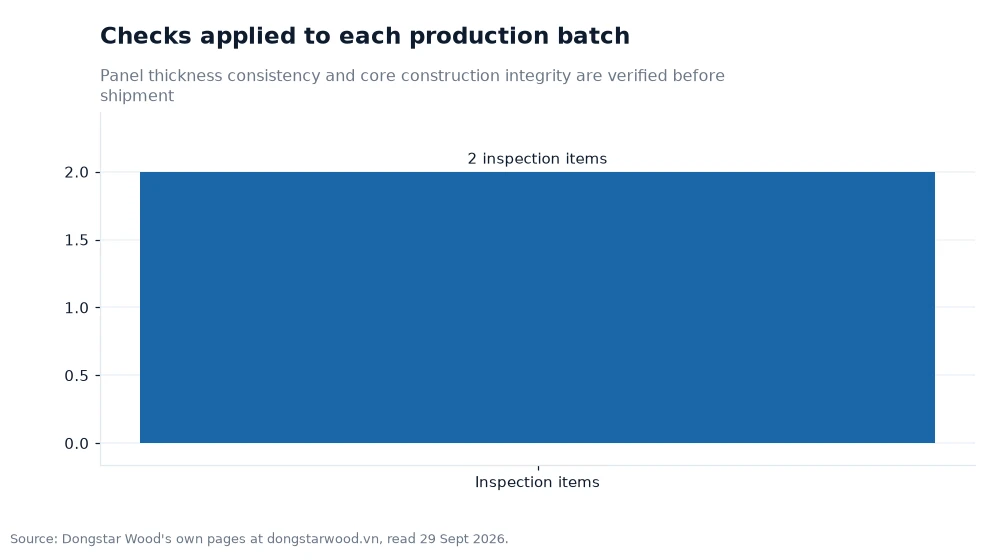
The page names the process in four steps: quality inspection comes last, after moisture-controlled drying, multi-layer panel assembly and high-pressure hot pressing. The drying step is the one that matters most for a cost-controlled panel — veneer that enters the press at the right moisture content bonds evenly and stays flat, and veneer that does not shows up later as warped sheets and delaminated edges. The batch inspection items are panel thickness consistency and core construction integrity, the same two checks that protect any panel leaving the mill.
| Characteristic | Published detail | What it means on site |
|---|---|---|
| Core | Acacia veneers, Vietnam plantation forests | Stable, high-strength hardwood core |
| Adhesive | Melamine, ≈10 hours boiling test | Bond holds through wetting cycles |
| Reuse | Approximately 3–5 times | The pours-per-sheet budget |
| Best-selling thickness | 21 mm, then 18 mm | Stiffness for heavier spans |
| Most requested format | 1250 × 2500 mm | Fits standard European shuttering |
Worked example: sheets for a small programme
Example only, using the published figures. A programme that pours a small structure ten times needs shuttering that covers the formwork area once and survives ten pours. At the published reuse of 3–5 times, one set of panels covers the first three to five pours; a second set, or a re-allocation of the first, covers the rest. Each 1250 × 2500 mm sheet covers 1.25 m × 2.5 m = 3.125 m², so a 100 m² formwork face needs 100 ÷ 3.125 = 32 sheets per pour. Over ten pours with two sets cycling, the material budget is 32 × 2 = 64 sheets — the reuse count, not the sheet price, sets the number.
Frequently asked questions
How many times can the ordinary black panel be reused?
The page states a reuse of approximately 3–5 times under normal site conditions. The count depends on the handling, the edge care and the exposure the panel receives between pours.
What is the core made of?
Acacia veneers from Vietnam plantation forests. The page describes acacia as a hardwood with excellent density and strong load-bearing capacity, and in this panel the acacia core carries the structural load.
Which thickness and format should be specified?
For European buyers the best-selling thickness is 21 mm, then 18 mm, and the most requested format is 1250 × 2500 mm. The thicker panel sells first, which points to heavier spans rather than the lightest sheet.
From cost control to the right panel
Cost control is a specification, not a surrender: the core, the adhesive and the inspection are still engineered, and the reuse count is still published. The high-grade formwork range covers the programmes that need the 10–20 cycle ceiling, and the mill's profile confirms the lines and the certifications behind both. Contractors who match the panel to the pour count tend to buy the right sheet once instead of the wrong sheet twice.
Data points in this article originate with the manufacturer's pages at dongstarwood.vn on 29 Sept 2026[1].