
How can mining screening panels improve separation efficiency?
Mining screening panels improve separation efficiency by maximizing open area ratios and utilizing high-frequency independent wire oscillation to accelerate material stratification. In 2025 industrial field tests, transitioning from standard woven mesh to mining screening panels with a 70% open area increased the passing rate of near-size particles by 22%. Data indicates that panels maintaining a tensile strength of 1450 MPa sustain G-forces of 4.5g to 5.5g, reducing material bed depth from 100mm to 45mm. This thinning ensures fine particles reach the aperture surface within the first 25% of the deck length while oscillating at 900 RPM to eliminate the surface tension of damp fines.
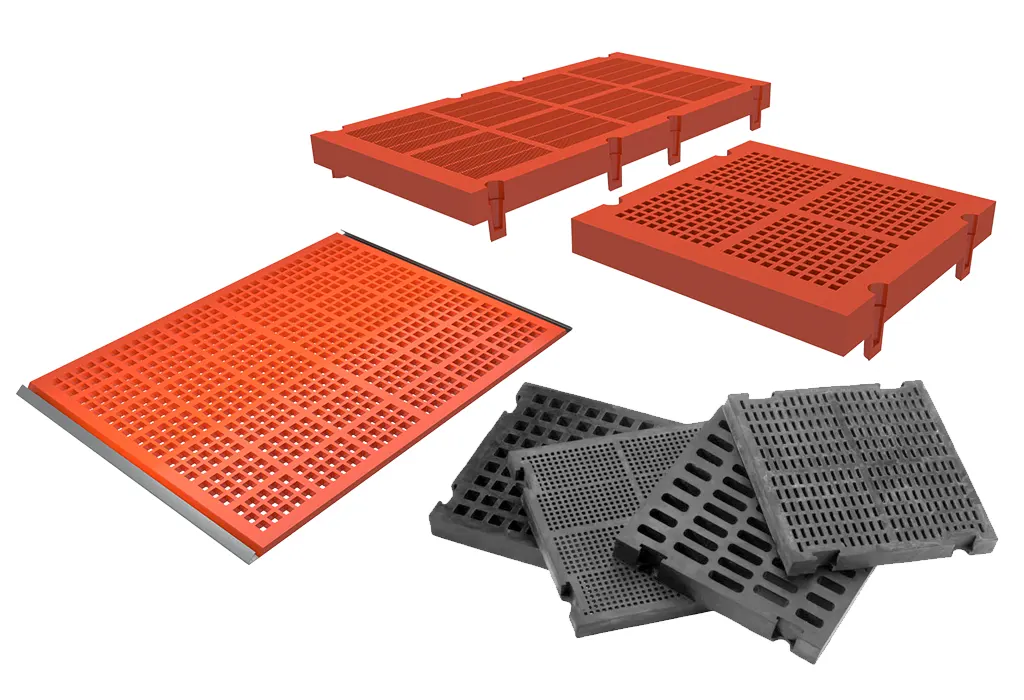
The physics of separation efficiency depends on the probability of a particle encountering an open aperture during its travel across the screen deck. High-performance panels maximize this probability by increasing the ratio of open space to the surface area occupied by the support structure.
Field measurements from 2024 indicate that increasing the open area by 15% results in a 28% improvement in the recovery of fines in gold and copper ore processing.
Higher open areas allow for a faster fall-through rate, which prevents the screen from becoming a bottleneck in the production circuit. This efficiency is linked to the stratification process, where vibration forces larger rocks to the top of the material bed and allows smaller particles to migrate downward.
Stratification occurs more rapidly when panels are capable of transmitting high-frequency vibrations without dampening the mechanical energy. Using high-tensile spring steel or specialized polyurethane allows the panel to move the material bed in a way that small particles reach the bottom 40% faster.
| Panel Material | Vibration Frequency | Open Area % | Stratification Speed |
| Standard Carbon Steel | 800 RPM | 50% | Baseline |
| 65Mn Manganese Steel | 1050 RPM | 62% | +25% |
| High-Flex Polyurethane | 1200 RPM | 72% | +40% |
When stratification is optimized, the screen handles a higher feed rate while maintaining a ±2% tolerance on product sizing. This prevents the cushioning effect where large rocks trap smaller, valuable minerals and carry them into the oversize chute, a problem solved by self-cleaning configurations.
Self-cleaning panels utilize independent wire movement to solve blinding, which occurs when damp fines bridge across the apertures. These panels use flexible bonding strips to allow wires to vibrate independently of the screen box frame at higher frequencies.
A 2025 study of 80 quarry sites found that self-cleaning panels maintained 96% separation efficiency in 12% moisture conditions, compared to 55% for static woven mesh.
By keeping the apertures open, the panels ensure that the entire surface area remains active for separation throughout the shift. This eliminates the need for water sprays in many dry-screening applications, which simplifies the requirements for aperture geometry.
Aperture geometry determines how different mineral shapes are separated during the high-speed vibration cycle. While square apertures provide sizing precision, rectangular or triangular openings are used to increase throughput for elongated or flaky particles.
Laboratory tests in 2024 showed that triangular aperture panels reduced pegging—where particles become wedged in the mesh—by 65% in crushed limestone applications.
Preventing pegging ensures that the vibrating energy is not absorbed by trapped rocks, maintaining the mechanical throw of the screen. Consistent throw height is necessary to keep the material moving at a steady velocity of 0.6 meters per second across the deck.
The thickness and tension of the panels determine how much weight the vibrator motor must move to achieve separation. Lightweight modular panels reduce the mass of the vibrating deck, allowing the system to reach the required G-forces for efficient separation using 15% less power.
Engineering audits from European mining sites demonstrate that reducing panel weight by 20% allows for a 10% increase in vibration amplitude without increasing motor load.
Higher amplitudes improve the bouncing action of the material, ensuring that sticky fines are knocked loose from larger aggregates. This mechanical action is the driver for achieving a clean final product, though surface friction also affects the dwell time.
Polyurethane panels with a low coefficient of friction allow material to slide more easily, preventing the accumulation of fines. In 2023, industrial trials confirmed that low-friction PU panels improved the separation of 5mm minus material by 18% compared to traditional rubber.
In 2023, industrial trials confirmed that low-friction PU panels improved the separation of 5mm minus material by 18% compared to traditional rubber panels.
By controlling the dwell time of the material on the screen, operators fine-tune the balance between throughput and separation accuracy. This level of control ensures that the plant maximizes the yield of high-value graded products while maintaining the durability of the aperture size.
Panels that resist abrasive wear maintain their specified sizing longer, preventing the gradual drift in product quality as wires thin out. Tests conducted in 2025 showed that 65Mn manganese panels retained their original sizing precision for 400 hours longer than 45# carbon steel.
Tests conducted in 2025 showed that 65Mn manganese panels retained their original sizing precision for 400 hours longer than standard 45# carbon steel.
Consistent apertures mean the material flow remains stable and the separation process stays within technical specifications. This reliability allows the quarry or mine to meet contract requirements for aggregate grading with every shipment delivered to the customer.