
From Share to Balance: How Pool Mining Turns Hash Into Coin
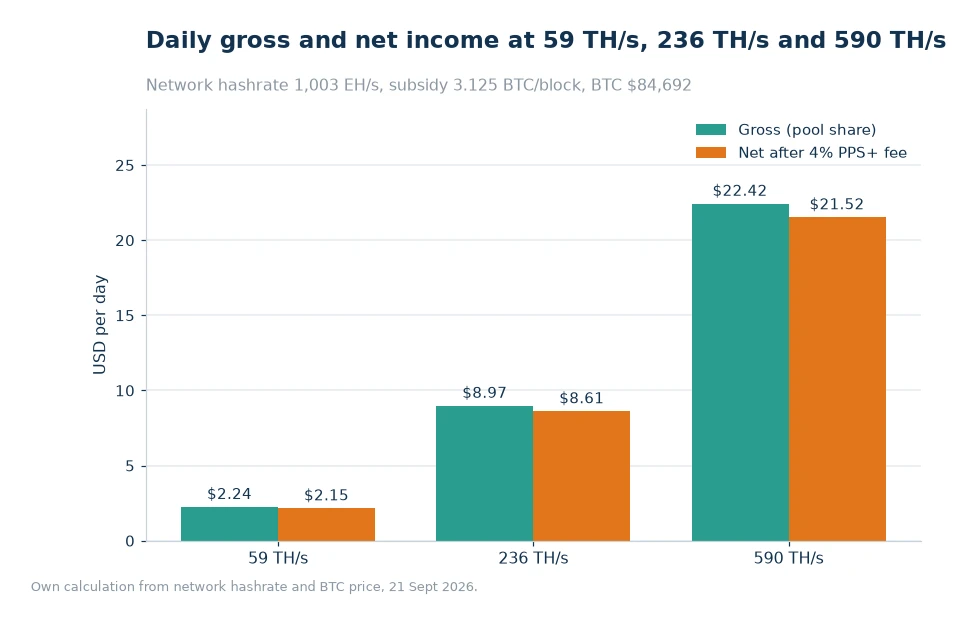
Between the moment a miner submits a share and the moment a coin lands in the wallet sits a chain of small accounting steps, and most of them are invisible until something looks wrong. At 59 TH/s the whole chain produces 2.647e-05 BTC a day, roughly $2.24 at $84,692 per BTC and $2.15 after the listed 4% on the block-reward component. At 590 TH/s the same chain delivers 0.00026468 BTC and $22.42 gross.

Key takeaways
- 59 TH/s earns 2.647e-05 BTC a day, $2.24 gross and $2.15 net; 590 TH/s earns 0.00026468 BTC and $22.42 gross.
- A share is proof of work submitted to the pool, not a block found on the network, so one share carries no reward of its own.
- PPS+ credits hourly against current difficulty; PPLNS waits for 6 confirmations and shares the last 5 difficulty rounds.
- The pool serves more than 150 countries and 20-plus coins, so the same account structure covers more than one chain.
A share is not a block
Miners solve a hash puzzle at a difficulty set by the pool, which is far easier than the network difficulty. Each solution is a share: evidence that the machine did a measurable quantity of work. The pool counts shares, and when a miner somewhere in the pool happens to find a solution that also clears the network threshold, that share becomes a block and the pool collects the 3.125 BTC subsidy plus the transaction fees inside it.
The distinction explains most of the confusion in a first month. Your machine might run for days without contributing to a block, and that is normal, because blocks are rare and shares are frequent. What you are paid for under PPS+ is the share count converted into a claim on the pool's expected output, not a direct share of a specific block.
What pool hashrate is telling you
Pool hashrate is the sum of every machine currently pointed at the pool. It matters for one reason: it sets the denominator of your slice. If the pool controls 3% of the network and you control 0.001% of the pool, your claim is a very small fraction of the 450 BTC minted each day, and no amount of pool growth changes your share of that pool unless you add hash yourself.
Pool luck is the other half of the picture, and it is the measure of how many blocks the pool found against how many it was expected to find in a window. Under PPLNS, luck lands directly on your income, because the pool only distributes what it actually earns. Under PPS+, the pool absorbs that variance and charges a higher listed rate on the block-reward component for doing so. Neither arrangement changes the long-run average much; they change who carries the swings.
The two settlement routes in plain terms
PPS+ is the default and pays every hour against current difficulty. The listed rate is 4% on the PPS-settled block reward and 2% on the transaction-fee component. The fee is charged on two different bases, which is why a single blended figure misrepresents it.
PPLNS carries a listed 2% on the block reward and fees combined. It settles after a block reaches 6 confirmations and allocates each miner a portion based on their slice of pool hashrate across the last 5 difficulty rounds. A miner who joins mid-window earns from the part of the window they were present for, and a miner who leaves stops earning once the window rolls past their last share.
Three hashrate levels, one set of inputs
The arithmetic below holds everything constant except hashrate, which is the only way to see what the pool formula actually does. Network hashrate is 1,003 EH/s, the subsidy is 3.125 BTC per block over 144 blocks, and BTC is $84,692.
| Hashrate | BTC per day | Gross per day | Net per day | Net over 30 days |
|---|---|---|---|---|
| 59 TH/s | 0.00002647 | $2.24 | $2.15 | $64.50 |
| 236 TH/s | 0.00010588 | $8.97 | $8.61 | $258.30 |
| 590 TH/s | 0.00026468 | $22.42 | $21.52 | $645.60 |
Nothing in the table assumes a lucky pool or an unlucky one. It is the expected value of the slice, and expected value is what a monthly plan should be built on. The actual monthly total under PPLNS will wander around the figure in the last column; under PPS+ it will track it more closely, at the cost of the higher listed rate on the block-reward side.
Worked example
Follow 59 TH/s from raw hash to a balance, then repeat the last step at ten times the size.
- Hashrate share: 59 divided by 1,003,000,000 TH/s gives 5.882e-08 of the network.
- Daily coin output: 5.882e-08 multiplied by 450 BTC gives 2.647e-05 BTC.
- Gross value: 2.647e-05 BTC multiplied by $84,692 gives $2.24.
- Listed fee on the block-reward component: 4% of $2.24 is $0.09.
- Net per day: $2.24 minus $0.09 is $2.15, or 0.00002541 BTC.
- Hourly credit under PPS+: 2.647e-05 divided by 24 is about 1.10e-06 BTC.
- Quadruple the hash to 236 TH/s: 0.00010588 BTC, $8.97 gross, $8.61 net.
- Ten times the hash, at 590 TH/s: 0.00026468 BTC, $22.42 gross, 4% of which is $0.90, leaving $21.52.
- Thirty days at 590 TH/s: $672.60 gross, $26.90 of listed fee, $645.60 retained before power.
Four things that surprise new pool miners
The first is a balance that starts at zero and stays there for an hour, which is exactly what hourly settlement looks like and not a fault. The second is a share count that drops when difficulty rises, because the same machine solving a harder puzzle produces fewer shares for the same work. The third is a payout that arrives in a different coin from the one you mined, which happens when a merged-mining chain pays out alongside the primary one.
The fourth is a withdrawal that costs nothing. Zero-fee mining payouts mean the transfer itself does not take a cut, so the number on the dashboard is the number that moves, minus the network's own fee treatment for the coin you chose. That is worth checking once with a small amount rather than assuming it in a spreadsheet.
Reading the pool's own numbers
Two published figures do most of the diagnostic work. The live pool state shows pool hashrate and pool luck, which together tell you whether the pool is performing as expected in the current window. Difficulty, shown alongside, tells you what the next window will pay per share.
Compare those with your own dashboard once a week. A pool hashrate that jumps while your share of it falls is a signal that other miners added capacity, not that your machine broke. A luck figure that stays poor across many windows is worth a second look, and it is the kind of thing a pool publishes rather than hides.
The ViaBTC Mining Pool puts the pool, the wallet and the payout history behind one login, which shortens the distance between a published figure and your own balance. For an operator running one or two machines, that convenience is the difference between checking the numbers weekly and never checking them at all.
Frequently asked questions
Is one share worth anything on its own?
No. A share is proof that a machine performed work at the pool's difficulty, and it earns a claim on pool output rather than a reward by itself.
Why did my income change when my hashrate did not?
Because output depends on network difficulty and BTC price as well as your hash, and a difficulty adjustment or a price move changes the dollar value of the same coin amount.
Does pool luck affect PPS+ income?
No. PPS+ pays hourly against current difficulty, so the pool carries the block-finding variance and the listed 4% on the block-reward component is what that costs.
Check the chain once, then trust the routine
Trace one day of output from hashrate to BTC to dollars to balance, and the pool stops being a black box. After that, the weekly job is a comparison: reported hashrate against expected hashrate, credited BTC against the formula, and net dollars against the power bill. Any gap points to a specific cause, and a specific cause can be fixed.
Sources: published fee and settlement terms[1], with chain inputs read 21 Sept 2026: network hashrate about 1,003 EH/s, difficulty 132.76 T, subsidy 3.125 BTC per block across 144 blocks a day, BTC at $84,692, and a next-adjustment estimate of -2.12%. Figures read 21 Sept 2026, published 22 Oct 2026. All dollar figures are arithmetic on those inputs.