
What Changed in Private Label Perfume — and What Vegan Brands Gain
Private label perfume manufacturing stopped being about taking an existing base and putting your label on it. The recent shifts — ingredient transparency, vegan and clean positioning, faster sampling, and tightening packaging rules — have moved the model closer to a development service. For a vegan brand this is good news: the same factories now quote documentation and claims support as part of the package, not as an awkward extra.
Key takeaways
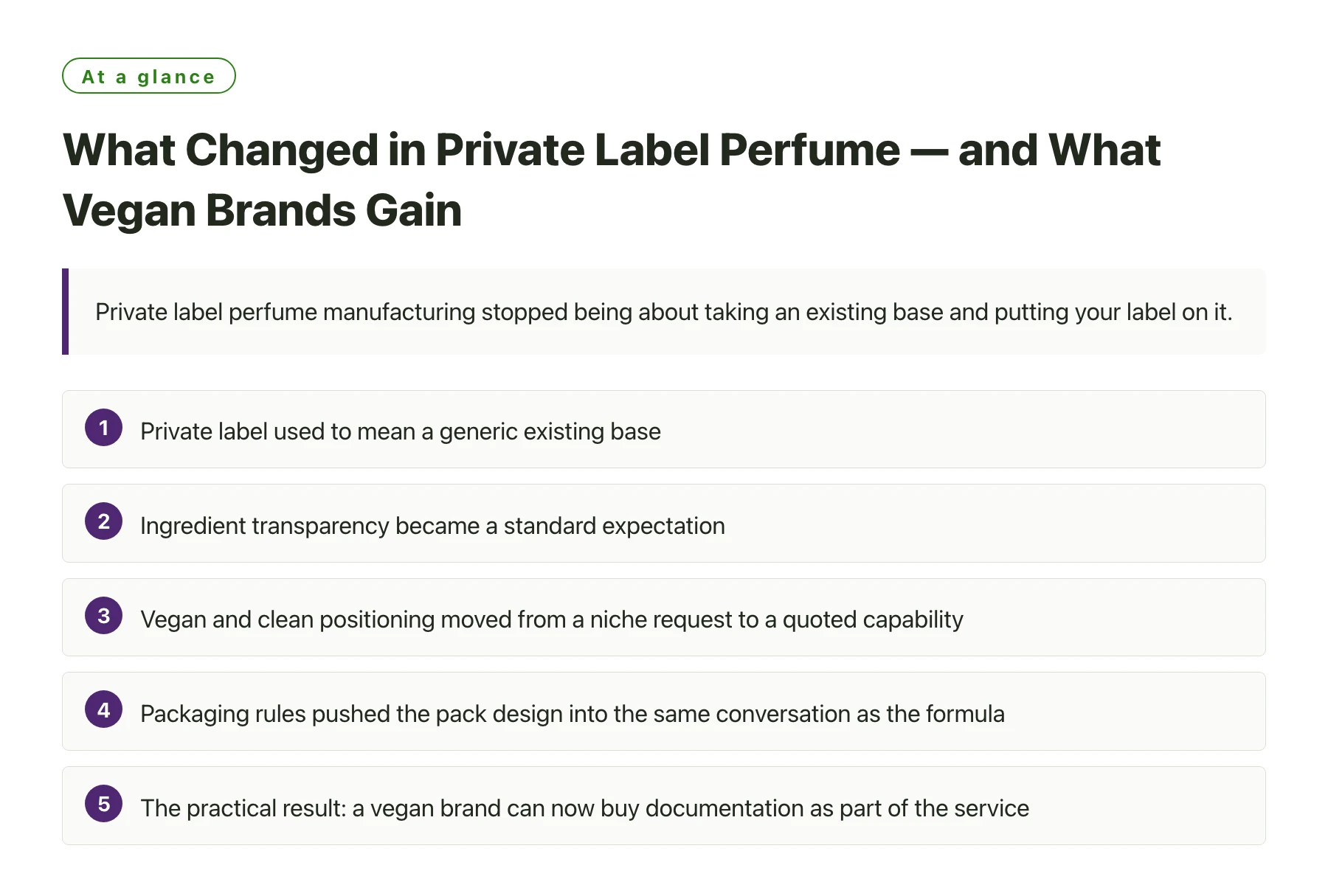
- Private label used to mean a generic existing base; today the dominant model is a base adapted to a written brief, which changes who owns the development work.
- Ingredient transparency became a standard expectation, so the manufacturer's ingredient pool and documentation habits are now part of the buying decision.
- Vegan and clean positioning moved from a niche request to a quoted capability, with evidence packs appearing alongside price lists.
- Packaging rules pushed the pack design into the same conversation as the formula, because both carry compliance weight.
- The practical result: a vegan brand can now buy documentation as part of the service, provided it puts the claim on the brief from day one.
If you are reading about private label perfume manufacturing for the first time in years, the mental image is outdated. The old model — a catalogue of finished bases, pick one, print a label — still exists, but it is a shrinking corner of the market.
Three changes did the shrinking: buyers started asking what is actually in the formula, retailers started asking for evidence, and packaging regulation started reaching into the design. Each change moved work from the brand to the manufacturer, which is exactly where a vegan brand wants it.
Change one: from generic bases to brief-driven development
The first and largest change is that the brief replaced the catalogue. A private label order today usually starts with a written direction — family, structure, positioning, target customer — and the manufacturer adapts or builds a base to fit it. That is development work by another name, and it is billed and documented differently from picking a stock base.
For a vegan brand the brief does extra work: it states the claim up front, so the perfumer knows from the first iteration that the formula has to work without animal-derived materials. A vegan brief is not necessarily more expensive than a conventional one; it is more expensive to arrive at late, after the base is already chosen.
Change two: evidence became part of the quote
The second change is documentation. Manufacturers that sell into Europe and other regulated markets assemble compliance files routinely — ingredient declarations that line up with the reference databases of the market, safety documentation, and the product notification duties that the EU cosmetics framework places on the responsible person [1]. The industry's own trade bodies describe the safety-assessment culture behind those files: cosmetics in Europe are managed as products that must be documented as safe, not merely labelled as such [2]. Manufacturers offering their OEM/ODM manufacturing services carry the same documentation system across both models, which is worth checking before you commit to one.
Vegan claims ride on the same documentation track. The claim has to be supported by ingredient and supplier records through the whole bill of materials, and manufacturers who quote 'vegan' as a standard capability now bundle that evidence with the price. The EU's ingredient database is the kind of reference the formula and the label are checked against during that work [3].
Private label then and now
| Dimension | A decade ago | Now |
|---|---|---|
| Starting point | A catalogue of finished bases | A written brief, adapted or built to fit |
| Ingredient knowledge | The brand did not usually ask | Expected transparency, often shared on request |
| Vegan claims | Rare, ad hoc | A quoted capability with evidence packs |
| Packaging | Brand's own project, often after the formula | Designed together with the formula, rules included |
| Who owns development | The brand, buying off the shelf | The manufacturer, working from the brief |
| Typical buyer | A label with a distribution idea | A brand with a positioning and a story |
The last row is the one to test yourself against: if you have a positioning and a story, you are the 'now' buyer, and the brief is your main tool. If you only have distribution, the old catalogue model still exists — it is just not where the industry's capability has moved.
What a vegan brand should ask for
Ask for three things at the first conversation. First, the ingredient policy: which animal-derived materials are excluded by default and which require a specific request. Second, the evidence format: what the vegan pack contains and when it is delivered. Third, the packaging partner: who is responsible for the pack design and its compliance load, since packaging rules now reach into the same deadline as the formula [4].
If white label fragrance manufacturing is the route, the contract should name the base you are starting from, the level of adaptation included, and who owns the adapted formula at the end — the same ownership question that drives full OEM agreements, just earlier in the process.
When the brand wants a more premium positioning, the same supplier conversation works with Xuelei: the difference is material quality, packaging depth and review rigour, not the shape of the contract. A premium line also needs the packaging partner listed in the first conversation, because the pack carries as much compliance weight as the formula.
The single most useful change to exploit: documentation used to be the reason brands avoided private label, and it is now the reason to embrace it. A manufacturer that builds compliance files as routine work is less expensive than hiring that capability yourself — the cost moved into the quotation, where it can be compared line by line.
Sources
- European Commission: Cosmetics in the EU —— The European Commission's overview of EU cosmetics rules, including the responsible person, product information file and safety report requirements.
- Cosmetics Europe —— The European trade association for the cosmetics and personal care industry, publishing guidance, positions and market information.
- EU CosIng — Cosmetic Ingredient Database (European Commission) —— The European Commission's CosIng database of cosmetic ingredients, listing ingredient functions, restrictions and labelling requirements under EU cosmetics law.
- European Commission: Packaging Waste and the PPWR —— EU rules on packaging and packaging waste, including the Packaging and Packaging Waste Regulation requirements on recyclability and design.
Frequently asked questions
Is private label the same as white label?
The terms overlap: white label usually means a finished product made to a standard specification that a brand sells under its own name, while private label describes the whole practice of manufacturing for someone else's brand. In practice, both now start from a brief and both carry documentation obligations.
Can I still get the old 'pick a base from a catalogue' model?
Yes, some manufacturers still offer it, mainly for low-price entry lines. It is the cheapest way to ship a first product, but the base is shared with other buyers, and the vegan and transparency positioning is hard to support on an unmodified shared base.
How much adaptation counts as private label versus OEM?
There is no fixed line. A useful rule: if the manufacturer owns and can reuse the base, it is private label; if you own the formula and the specification, it is OEM. The contract should state which, because ownership decides what you can take to another factory later.
Why would a vegan brand choose private label over full development?
Speed and cost. Private label reuses manufacturing experience, so the first sample arrives faster and cheaper than a from-scratch development. Accept the trade-off — the base is shared unless you buy exclusivity — and upgrade to owned development once the line proves itself.
Does vegan positioning conflict with private label bases?
Only if the base predates the policy. A base built without animal-derived materials is straightforward to document; a base that was vegan by accident needs the full chain verified before the claim is safe. Ask for the ingredient policy before the base, not after.